Zimbabwe Business eVisa Cost and Non-Tourist Visa Options for UK Travellers
A Zimbabwe business eVisa costs $55 single entry or $70 double entry for UK citizens, and you'll need two letters: one from your UK employer and one from a Zimbabwean host. This guide compares those fees with conference, transit, volunteering and filming routes - and explains when a work permit is legally required instead.
This is an independent guide for UK-based travellers, not a government site - you apply yourself through the evisa.gov.zw platform, so double-check current prices and rules there before you travel.
Business eVisa Cost: Fees for UK Citizens
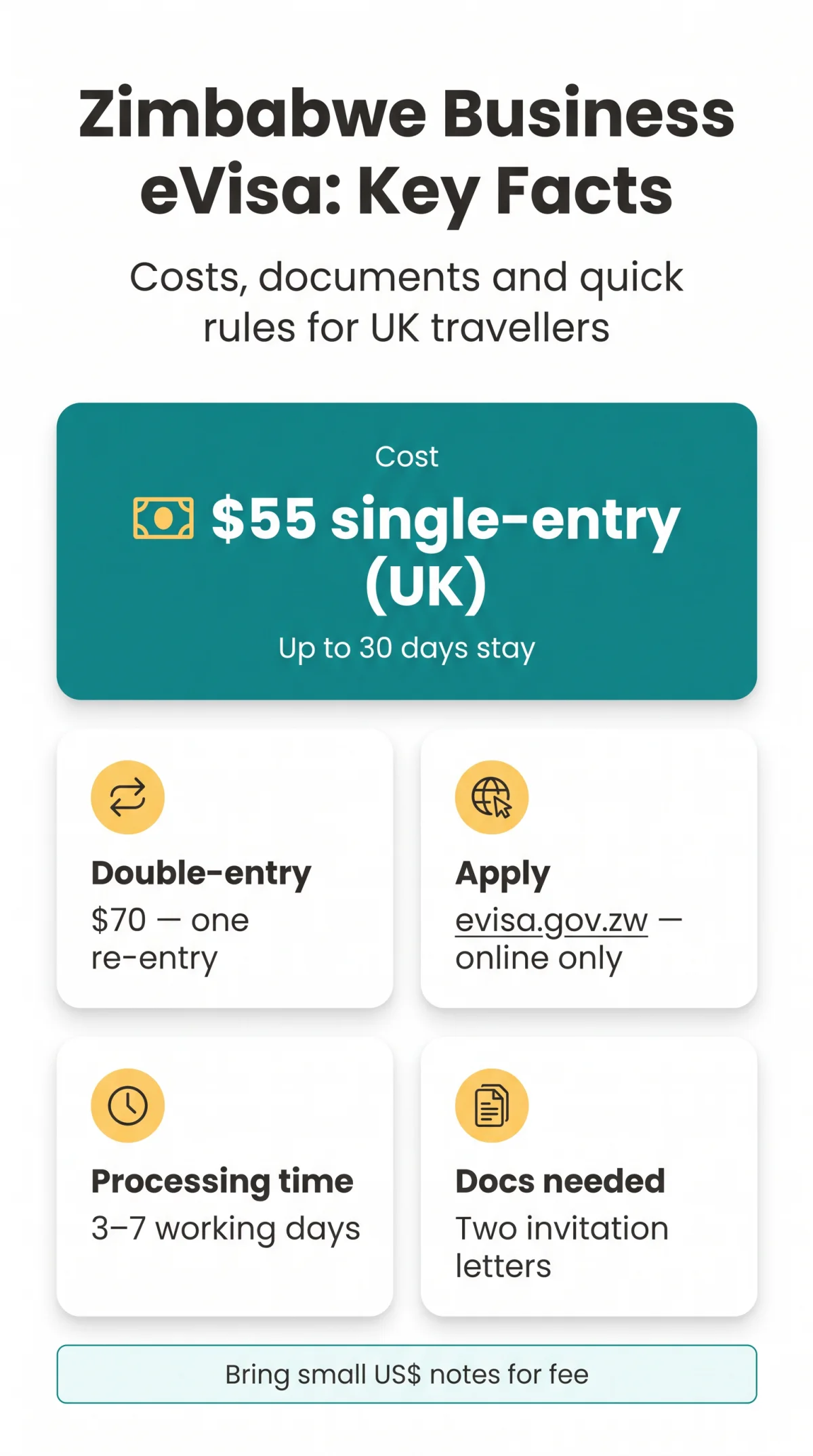
UK passport holders sit in a surcharged Category B band: $55 single entry, $70 double entry (some fee lists quote $75, so carry a small cash margin), payable online or on arrival - more than the standard Category B rate of $30/$45 that US, EU and Australian nationals pay. For a full breakdown of all visa fees in both dollars and pounds, see our Zimbabwe eVisa cost comparison.
A multiple-entry visa costs $90 for UK citizens, but you can't get it on arrival. You enter on a single-entry visa first, then apply in person at the Department of Immigration inside Zimbabwe - allow roughly 7 working days.
Your stay is up to 30 days, set at the port of entry, and the visa is non-renewable for short business visits. The $50 KAZA UniVisa won't substitute: it covers tourism between Zimbabwe and Zambia, plus day trips into Botswana, and stops being valid if you overnight in Botswana. We explain that trade-off in detail in our KAZA Univisa price guide for British tourists.
Single vs Double Entry: Which Fee to Pay
A single-entry visa dies the moment you leave Zimbabwe, even for a day. If your trip includes side visits to Zambia, Botswana or South Africa, pay the $15 extra for double entry - it buys you one clean re-entry. Our single vs double entry comparison covers the validity rules in full.
Children pay the full fee at any age, and under-16s can't apply alone - you must link their eVisa to an adult application, as explained in our guide to Zimbabwe visa requirements for minors.
Invitation Letters and Required Documents
Approval usually hinges on two letters. You need:

- Letter from your UK employer - confirms your role and the purpose of the trip.
- Host invitation letter from Zimbabwe - from the partnering company, explaining the nature of your business and your programme; the host company's registration documents may also be requested.
- Passport valid 6+ months from arrival with at least 3 blank pages (FCDO guidance)
- Return flight ticket and confirmed accommodation proof
- Two passport photos and a copy of your biodata page
- Bank statements covering 3 - 6 months
Keep printed copies of your visa, passport page, tickets and accommodation proof to hand. For the full document checklist, see what documents are required for an eVisa to Zimbabwe.
How to Apply and Total Cost Beyond the Fee
You apply yourself at evisa.gov.zw; standard processing takes 3 - 7 working days - our realistic processing time guide explains how to plan around that window. The Zimbabwean Embassy in London no longer issues visas, so online or on arrival are your only routes (gov.uk).
Select the business visa category.
They must match your passport letter for letter.
Provide legible copies of your supporting documents.
Payment is made by card.
You can then track the application on the portal.
Do this before you leave the UK.
Faster handling may be available for an extra fee, but it isn't guaranteed - apply 1 - 2 months ahead. Third-party agents add their own service fee on top of the government fee; sites that imitate the government platform are not connected to the Department of Immigration - check the address ends in ".gov.zw". At the border, card machines are unreliable, so take enough US dollars in small notes to cover the fee - change is rarely available. Declare cash or travellers cheques worth $10,000 or more on entry; you can export at most $2,000 unless your stamped entry declaration backs a higher amount. Overstaying can result in fines and other penalties.
Business Visa vs Work Permit: Legal Boundaries
The $55 visa covers meetings and inspections only. Anything hands-on or paid requires a Temporary Employment Permit (TEP) under Zimbabwe's Immigration Act [Chapter 4:02].
| Aspect | Business visitor visa | Temporary Employment Permit |
|---|---|---|
| Cost | $55 - $70 | Fee paid through the evisa.gov.zw application |
| Permitted activities | Board meetings, negotiations, site inspections, market research | Paid or hands-on work for a Zimbabwean employer or client |
| Sponsor needed | No, letters only | Registered Zimbabwean company |
| Approval body | Department of Immigration | Department of Immigration (application via evisa.gov.zw) |
The line is simple: meetings, negotiations and inspections are allowed; doing the paid work itself is not. Violating the gainful employment restriction risks arrest and deportation.
Volunteering follows the same logic. Unpaid work still counts as labour if it displaces a local role or delivers hands-on services. Short volunteering visits are usually registered under the business visa profile, but a temporary work permit is required for volunteering and missionary work, and anything beyond 30 days is treated as work. The permit application goes through your host organisation on evisa.gov.zw.
Conference, Transit and Filming Alternatives Compared
Other non-tourist routes range from a short, non-renewable transit visa to media accreditation obtained before departure. Here's how they stack up:
| Category | Cost | Max stay | Key requirement |
|---|---|---|---|
| Conference visa | Same Category B fee as business ($55 single entry, UK passports) | 30 days, non-renewable | Event organiser's invitation |
| Transit visa | Fee charged at the port of entry | Brief layover, non-renewable | Confirmed onward ticket and visa for the next destination |
| Business eVisa | $55 / $70 double | 30 days | Dual invitation letters |
| Volunteer TEP | Application and fee via evisa.gov.zw | Assignment-based | Host organisation sponsors the permit |
| Media accreditation | Fee not published in UK guidance | Production-dependent | Accreditation from the Zimbabwean Embassy in the UK before travel |
Conference delegates pay the same $55 but swap the two corporate letters for the event organiser's invitation. A transit visa allows passage only - attending any meeting on it breaks its terms. If you're weighing up applying online versus getting stamped at the border, our visa on arrival vs eVisa comparison covers the pros and cons for UK travellers.
Filming is the expensive outlier. A standard business visa won't cover any production. You need media accreditation from the Zimbabwean Embassy in the UK before you travel. Professional equipment must be declared to customs on arrival, as it may be subject to duty. Unaccredited journalists face arrest, detention, heavy fines and deportation.
Common Mistakes and How to Avoid Them
- Using the $50 KAZA UniVisa for business meetings. It is a tourism visa - book the business visa instead.
- Arriving without small US dollar notes. Change is rarely available at border counters, so bring the exact fee in small denominations.
- Confusing visa validity with your stay. Validity runs from the date the visa is issued, not from the date you enter; the stay itself, up to 30 days, is granted at the port of entry.
- Paying a third-party site's service fee on top of the $55 visa. Apply yourself at evisa.gov.zw and keep the difference.
Frequently Asked Questions (FAQ)
How much is the Zimbabwe business eVisa cost for UK citizens?
UK citizens pay $55 for single entry and $70 for double entry. A multiple-entry visa costs $90, but only through the Department of Immigration inside Zimbabwe - never on arrival.
Can I get a Zimbabwe visa on arrival for a business trip?
Yes. British passport holders are in Category B, so a visa can be issued at airports and land border posts once you pay the fee. Card facilities are unreliable, so take enough US dollars in small notes to cover the $55 single-entry fee, as change is rarely available at the counter.
How long does Zimbabwe business eVisa processing take from the UK?
Standard processing runs 3 - 7 working days via the eVisa portal. An extra fee may buy faster handling, but this isn't guaranteed, so apply 1 - 2 months ahead to fix any document problems.
What must a Zimbabwe business invitation letter include?
It should come from the partnering company in Zimbabwe and set out the nature of your business and your programme; the company's registration documents may also be requested.
Can I do volunteer work in Zimbabwe on a business visa?
Only for short visits. Volunteering and missionary work require a temporary work permit, and any stay beyond 30 days counts as work; the application goes through your host organisation on evisa.gov.zw.
What is the difference between a business visa and a work permit in Zimbabwe?
The business visa covers meetings, negotiations and site inspections. Any hands-on or paid work requires a TEP under the Immigration Act [Chapter 4:02]; the application goes through the sponsoring company on evisa.gov.zw.
Can I use the KAZA UniVisa for business meetings in Zimbabwe?
No. The $50 KAZA UniVisa is a tourism visa for travel between Zimbabwe and Zambia, with day trips into Botswana, and is valid for 30 days. For meetings, negotiations or site visits you need the business visa, which costs $55 single entry for UK passport holders.
Where do I apply for a Zimbabwe business eVisa online?
Apply at evisa.gov.zw. The Zimbabwean Embassy in London no longer issues visas. Lookalike sites have no connection to the Department of Immigration, so check the address ends in ".gov.zw".
Sources and Further Reading
- gov.uk FCDO Zimbabwe entry requirements - UK government guidance on visa fees, passport rules, cash limits and work restrictions.
- evisa.gov.zw - the Zimbabwe Department of Immigration's eVisa platform where you apply and track your reference number.
- Embassy of Zimbabwe in Germany - visas - a diplomatic mission page with the standard Category B fee structure.
Rules and fees can change, so confirm details on the government portal before your trip.