Zimbabwe Visa for British Passport Holders: Entry Requirements, Fees, and Travel Guide
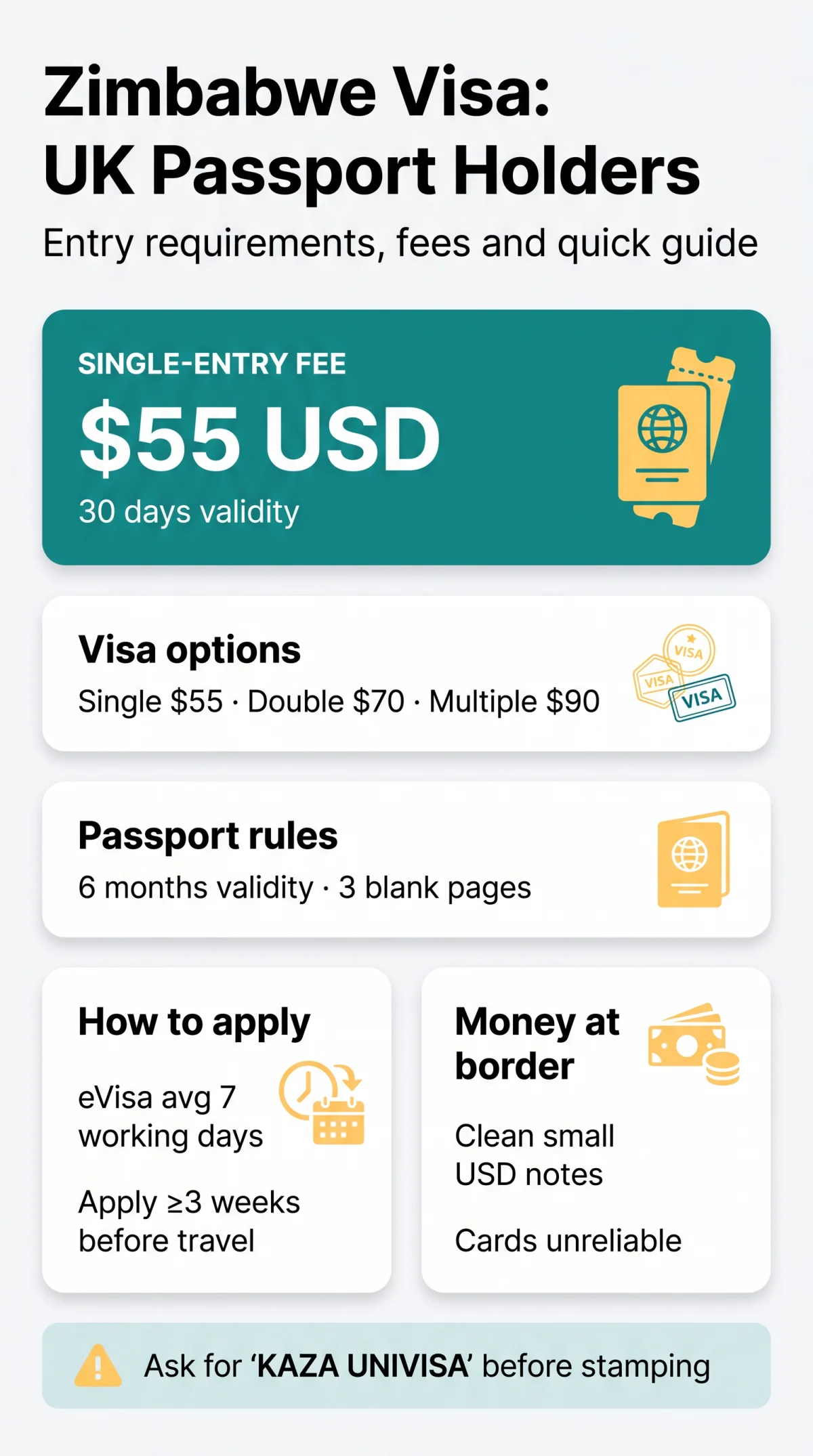
Yes - a Zimbabwe visa for British passport holders is required, but as a Category B traveller you can buy one on arrival or apply online before you fly. A single-entry tourist visa costs $55 USD, while the multi-country KAZA UNIVISA costs $50 USD. Your passport must be valid for at least six months beyond your arrival date.
This independent guide is for UK citizens planning a trip to Zimbabwe, and it doesn't charge fees or submit applications on your behalf. Always confirm current rules on the official eVisa platform before you travel.
Do British Citizens Need a Visa?
Category B Status: No Advance Visa Clearance Needed
You don't need to arrange a visa before departure. Zimbabwe classifies UK passport holders as Category B travellers, which means you can get a visa on arrival or submit an online pre-application before you fly.
Category B doesn't mean visa-free - it means immigration issues your visa at the port of entry or online, so you never need to visit an embassy in London. Some travellers prefer sorting it online in advance, especially for smaller land borders.
Permitted Length of Stay and Visa Validity Windows
The visa on arrival is usually granted for 30 days, and the permitted stay is set by immigration at the port of entry. How long your visa lasts depends on which type you buy: single entry runs 30 days from issue, double entry 90 days, and multiple entry 180 days - our comparison of single entry vs double entry validity and stay limits breaks this down in detail. The KAZA UNIVISA is valid for 30 days from the date of issue and cannot be extended.
Official eVisa processing averages seven working days, and the portal recommends applying at least three weeks before travel.
Visa Options and Fees for UK Citizens
British travellers pay $55 USD for single entry, $70 USD for double entry, $90 USD for multiple entry, or $50 USD for the KAZA UNIVISA.
| Visa type | Fee (USD) | Validity from issue | Entries |
|---|---|---|---|
| Single entry | $55 | 30 days | One |
| Double entry | $70 (some ports quote $75) | 90 days | Two |
| Multiple entry | $90 | 180 days | Unlimited within validity |
| KAZA UNIVISA | $50 | 30 days from the date of issue, non-extendable | Zimbabwe - Zambia unlimited, plus Botswana day trips |
Standard Visa Fees: Single vs Double Entry
You can pay online when you pre-apply; at the counter, payment is made in cash in small US dollar notes (card payment is not always possible). Because some ports and agents quote the double-entry visa at $75 rather than $70, carry enough cash to cover the higher figure.
Multiple entry on arrival is available to UK, USA and Canada passport holders; British travellers are charged $90. To avoid complications at smaller crossings, apply for that one online in advance.
The KAZA UNIVISA Advantage for Multi-Country Trips
There's a pricing quirk worth knowing: the KAZA UNIVISA costs less than a plain single-entry Zimbabwe visa, yet it also covers Zambia and day trips into Botswana via Kazungula. If you're only visiting Zimbabwe, single entry does the job - the KAZA is cheaper, but it is a multi-country visa and is not always issued, so don't count on it.
State clearly at the counter which visa you want before the officer stamps anything, or officials may default to the more expensive single-entry option. To weigh up whether the combined visa suits your itinerary, see our guide to the KAZA Univisa price for British tourists.
KAZA has limits: it's valid for 30 days from the date of issue, can't be extended, and you can get a maximum of three per year. An overnight stay in Botswana immediately voids it - day trips through Kazungula only.
Passport and Document Requirements
Your British passport must have at least six months of remaining validity beyond arrival and a minimum of three blank pages.
Three blank pages are required so you can enter Zimbabwe and exit through a neighbouring country, or leave at short notice.
Port of Entry Document Checklist
- Valid British passport (six months validity, three blank pages)
- Return ticket or proof of onward travel
- Proof of sufficient funds for your stay
- Accommodation details and trip purpose documentation
- Travel documents required for your next destination
- Visa fee in clean, undamaged small-denomination USD notes
- Completed Immigration Declaration Form (digital or paper)
Travellers often confuse three documents that serve different purposes. If you applied online, make sure you understand how the eVisa Approval Letter printout works before you fly, and if you're filling in paperwork at the border, our walkthrough of the Zimbabwe Immigration Declaration Form explains what to show and when.
| Document | When you need it |
|---|---|
| eVisa Approval Letter | Only if you applied online - show it on arrival |
| Immigration Declaration Form | At the border, before the officer processes you |
| Visa stamp | Entered in your passport once the fee is paid |
How to Apply: Visa on Arrival vs eVisa
You can buy a visa at the border counter, or complete an eVisa application online at least three weeks before you travel (processing averages seven working days). If you're undecided between the two routes, read our comparison of the visa on arrival vs eVisa for UK travellers.
Option 1: Visa on Arrival at the Port of Entry
Option 2: Applying Online via the eVisa Platform
A typo invalidates the visa.
A clear passport scan and photograph.
Pay the fee online and submit at least three weeks before travel.
Pack it with your passport.
The official turnaround averages seven working days; some agencies estimate up to ten business days. Children under 16 can't apply independently - if they travel with an adult, they must be included in that adult's application.
Application Traps and Non-Refundable Fees
Once your eVisa is issued, you can't change the travel date or your passport details. If the visa data doesn't match your passport, the eVisa is invalid - you must either create a new application or contact the Immigration Office for assistance. Fees are never refunded for unused, rejected, or cancelled visas, and immigration may reclassify your visa type and fee during processing. If your application runs into problems anyway, see what to do after a rejected Zimbabwe eVisa application.
Money Rules at the Border: USD Cash Protocol
Carry clean, undamaged US dollar notes, because card payments at ports of entry are unreliable and cash departures are capped at $2,000 USD.
Accepted US Dollar Notes vs Card Terminal Failures
Bring clean notes in small denominations, because change is rarely available.
Card machines at ports of entry are unreliable for visa payments, and some businesses do not accept cards at all. Treat cards as a bonus, not a plan, and carry enough backup cash to cover your visa fee and first day's expenses.
Currency Declarations and the $2,000 USD Export Limit
You must declare cash or traveller's cheques totalling $10,000 USD or more on arrival. When leaving, it's illegal to depart with more than $2,000 USD in cash unless you have certified import declaration forms from your arrival.
Exchange money only at registered banks and bureaux de change.
Flying from Britain: Routes, Layovers, Yellow Fever
A yellow fever certificate is required if you arrive from a country listed as a transmission risk, or if you have been in transit more than 12 hours at an airport in such a country (Kenya is on the list - check the full list before booking).
The 12-Hour Transit Rule for Layovers in Risk Countries
A yellow fever certificate is mandatory for travellers aged nine months and above arriving from countries listed as transmission risks, or after transit of more than 12 hours at an airport in such a country - Kenya is on the list, so check the full list before booking.
Landing in Harare or Victoria Falls without the certificate after a long Nairobi layover can mean being turned away at health screening. Get vaccinated and carry the certificate with your passport. Port-of-entry health inspections can also happen during disease outbreaks, regardless of your route.
Malaria risk exists nationwide, so ask your GP about prophylaxis before flying. Hepatitis A and B and typhoid vaccinations are also recommended, and tsetse fly precautions apply in the Zambezi basin.
Entry at Harare vs Victoria Falls Airport
Most British visitors arrive at Robert Gabriel Mugabe International Airport in Harare or Victoria Falls Airport. Both handle visas on arrival and issue the KAZA UNIVISA, along with Joshua Mqabuko Nkomo International Airport in Bulawayo and the Victoria Falls and Kazungula land borders.
Special Cases: Minors, Dual Nationals, Local Laws
UK minors pay full visa fees, and camouflage clothing is illegal for all visitors.
UK Minors Travelling with One or Neither Parent
Children of any age, including infants, pay full visa fees - the old exemptions are gone. A child under 16 travels on an accompanying adult's online application rather than their own. For a deeper look at family travel, read our guide to Zimbabwe visa requirements for minors under 18.
Dual Nationals and Emergency Travel Documents
If you hold both British and Zimbabwean citizenship, decide before departure which passport you'll use, and carry the other if you have it. Check your entry position with the Zimbabwean Embassy in London if you're unsure which document applies.
UK Emergency Travel Documents are accepted at most major ports of entry, provided they remain valid for your whole intended stay.
Local Prohibitions: Camouflage, Photography, Media Rules
Camouflage-patterned clothing is illegal for civilians, and photographing government buildings, military installations, State House, police, or armed forces personnel is banned.
Journalists, including news photographers, must get accreditation from the Zimbabwean Embassy in the UK before travelling. The definition of journalism is applied broadly and can cover interviews, filming and photography, so be cautious about posting, blogging or filming. Volunteer or missionary work - paid or unpaid - can't be done on a tourist visa; you'll need a Temporary Work Permit or Business Visa arranged before travel. UK law also prohibits taking firearms into Zimbabwe, and uncertified gemstones and pornographic material are banned.
Extending Your Stay
Visas and permits can be extended or renewed in person at the Government of Zimbabwe Immigration Department - extensions are not handled online. Start the process before your current visa expires. The KAZA UNIVISA is the one visa you can never extend - plan around it or buy a new one (up to three per year).
Navigating Online Services and Avoiding Unofficial Visa Traps
Apply directly through the government eVisa portal to avoid the service fees that third-party commercial agencies add on top of the government fee. Zimbabwe's own eVisas are issued only through https://www.evisa.gov.zw/; the KAZA eVisa can also be applied for through the Zambian government portal, in which case the trip must start in Zambia.
Commercial agents charge a service fee for the same application, while fraudulent sites impersonate the Department of Immigration - check the address bar before entering card details or uploading your passport scan. Cross-check fees and processing rules on GOV.UK's Zimbabwe entry requirements page.
Common Mistakes at the Border
- Bringing worn or large notes. Damaged notes and big bills cause problems because change is rarely available and ATM access isn't guaranteed. Order clean, small-denomination notes before departure.
- Typing the passport number wrong on the eVisa. A single mismatched digit invalidates the visa, and you pay again. Read the field back against your passport photo page.
- Not asking for the KAZA UNIVISA. Officers may default to the $55 single-entry visa. Say "KAZA UNIVISA, please" before anything is stamped.
- Ignoring the 12-hour transit rule. A long layover at an airport in a transmission-risk country such as Kenya makes a yellow fever certificate mandatory. Book the vaccination early - clinics need lead time.
- Flying out with too much cash. Departing with over $2,000 USD in cash is illegal without certified import forms. Declare large sums on arrival and keep the paperwork.
Frequently Asked Questions (FAQ)
Do British passport holders need a visa for Zimbabwe?
Yes, a visa is required. British passports fall into Category B, which means you do not have to hold a visa before departure - you can pay for and obtain one at the port of entry or pre-apply on the eVisa platform. The Embassy in London no longer issues visas. Your passport needs at least six months' validity from arrival and three blank pages.
Can UK citizens get a visa on arrival in Zimbabwe?
Yes. Single, double, and multiple entry visas are available on arrival at designated airports and land borders. The $90 multiple-entry option is specifically available to UK, USA, and Canada passport holders.
How much does a Zimbabwe visa cost for UK citizens?
Single entry costs $55 USD, double entry $70 USD (some ports quote $75), multiple entry $90 USD, and the KAZA UNIVISA $50 USD. Pay in clean USD cash or online.
How long does it take to get an eVisa for Zimbabwe?
Processing takes an average of seven working days, though the Department of Immigration does not guarantee that timescale. The eVisa platform asks applicants to submit at least three weeks before their travel date, so book your application well before you fly.
Do I need a yellow fever certificate when flying from the UK to Zimbabwe?
Only if you arrive from a country listed as a transmission risk, or if you have been in transit more than 12 hours at an airport in such a country - Kenya is on the list, so check the full list before booking. Travellers aged nine months and above need the certificate in those cases.
Where do I apply for a Zimbabwe visa online?
Applications go through the Zimbabwe Department of Immigration's eVisa platform at https://www.evisa.gov.zw/, where you complete the form, upload your documents and pay the government fee. Commercial agents can submit the same application for you, but they add their own service fee on top.
Can I visit Zambia and Botswana on a Zimbabwe visa?
The KAZA UNIVISA, which costs $50, allows unlimited travel between Zimbabwe and Zambia for 30 days and covers day trips into Botswana via Kazungula; an overnight stay in Botswana voids it. It is issued only at selected ports of entry and is not always available to British passport holders, so ask for it at the counter rather than assuming you will get one.
Can I volunteer in Zimbabwe on a tourist visa?
No. Volunteer and missionary work requires a Temporary Work Permit or Business Visa obtained before travel. Journalists and film crews also need advance accreditation from the Zimbabwean Embassy in London.
Sources and Further Reading
- GOV.UK - Zimbabwe entry requirements - passport validity, currency rules, and local laws for British travellers.
- eVisa Platform - Zimbabwe - the official online application portal.
- eVisa FAQs - Category B rules, visa types, and amendment limits.
Rules can change, so confirm current requirements on the official portal before your trip.