Zimbabwe Entry Declaration Form IF1 Form: How to Complete It and What to Show at the Border
The Zimbabwe entry declaration form IF1 (the IF1 form) is the online version of the arrival declaration card. Rollout is phased, so the paper form is still in use. You file it before departure, get a QR code, and show it at the border with your passport and visa. If you haven't filed online, you can still complete the declaration manually on arrival.
This guide is for UK holidaymakers, safari visitors and business travellers. It's independent advice, not a government site: we don't charge fees or file anything on your behalf. Read it, then check the details on the official eVisa platform before you fly.

What Is the Zimbabwe Entry Declaration Form IF1 Form?
The Department of Immigration, which administers the Immigration Act [Chapter 4:02], requires an arrival declaration from everyone entering Zimbabwe, and the IF1 form is its digital version. One airline asks passengers to file the declaration before departure, and the declaration itself must be completed before you arrive in Zimbabwe, though rollout is phased and border posts still keep paper slips.
Who files it? Everyone entering Zimbabwe, whatever the route: UK tourists, business visitors, returning residents and Zimbabwean citizens.
Form IF1 is a border declaration, not a visa. It records who you are and where you're staying, and it grants no right of entry on its own. On the eVisa portal, the declaration and the visa application are separate paths, and the visa fee is paid separately, online with the application or on arrival.
Cost, Timing and Portal Access
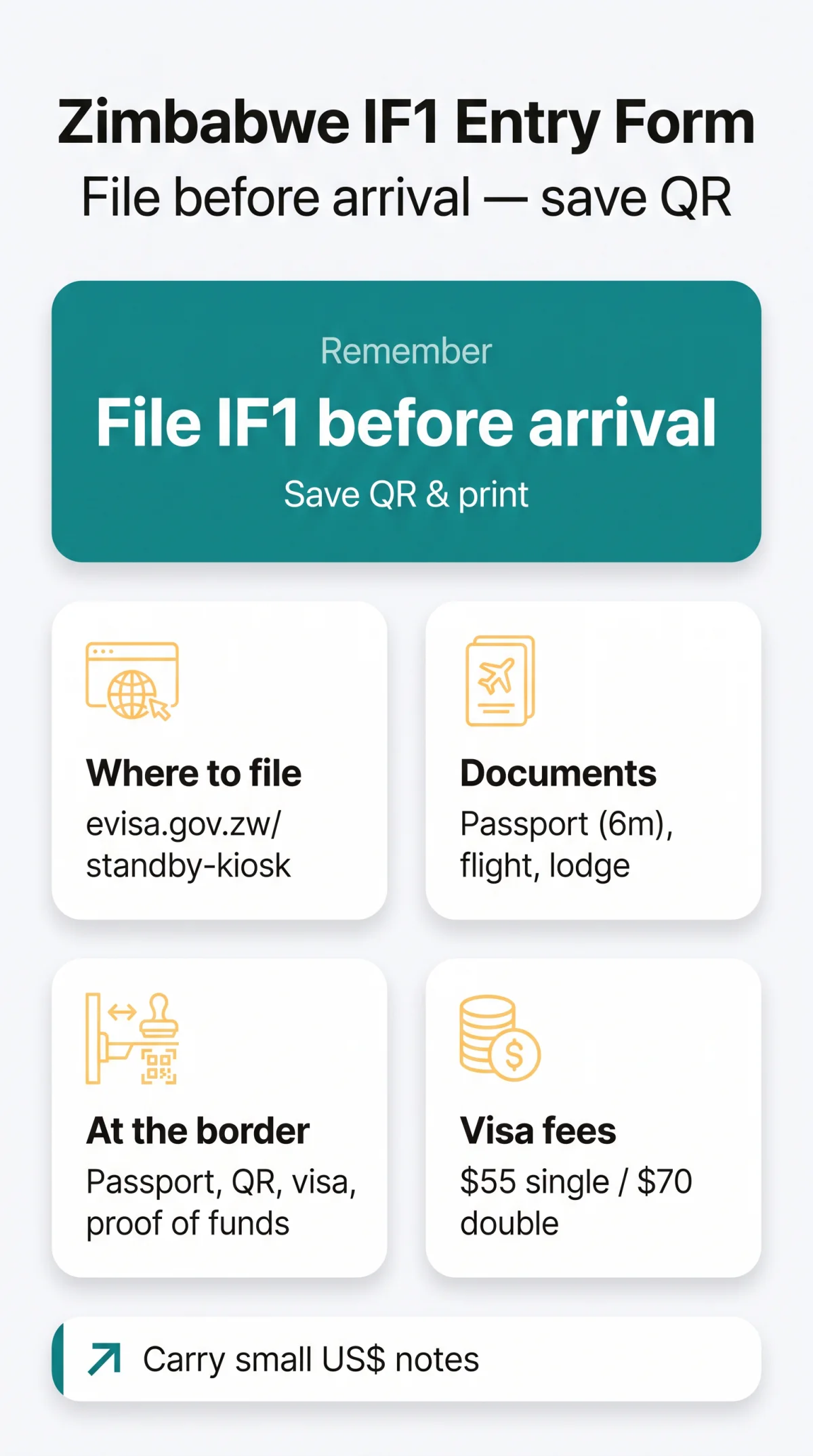
No fee is published for the declaration, so file it yourself on the government portal instead of paying an intermediary. The form lives on the platform's standby-kiosk page at https://evisa.gov.zw/app/index.html#/standby-kiosk.
| When | What you do |
|---|---|
| Before you travel | Confirm your flight number and first accommodation, then file the declaration |
| At the border | Ask for a paper IF1 slip if you couldn't file online |
Before you open the portal, have ready: a passport valid for at least six months with three blank visa pages (FCDO advises three; confirm with your travel provider), your flight number, your lodge's full address, your own phone, email and home address, an emergency contact's name, relationship, phone and email, and your travel funds figure.
Filling In the IF1 Form, Field by Field
Work through the form section by section, copying every name and number exactly as printed in your passport.
Surname and given names as printed in your passport, plus former names, gender, marital status, date of birth (DD/MM/YYYY), place of birth, nationality and occupation.
Type (Regular for UK tourists), number, issuing country, issue date, issuing authority and expiry date.
Arrival and departure dates, mode of travel (air, land, sea or other), your port of arrival and port of departure, your arrival flight number, funds for the trip, and companions under 18.
Full lodge name, town and district, then your UK emergency contact's name, relationship, phone and email.
For Zimbabwe and your home country (yes or no).
Save the confirmation with your QR code straight away.
Watch out for two traps: a typo in the passport number, and a second given name typed into the wrong field. Give the full address of your accommodation, including town and district, exactly as your booking confirmation shows it.
After You Submit: QR Codes and Border Paperwork
Submission generates an on-screen confirmation with your QR code. Save it offline at once: take a screenshot and print your confirmation before flying. Network problems at border posts are common, so don't rely on opening it online.
The portal publishes no edit option after submission. If a key detail such as the passport number is wrong, complete a new declaration and keep the newer confirmation; mention small slips to the officer at the desk.
At Harare or Victoria Falls, the officer will want your passport, the QR code on screen or paper, a return or onward ticket and proof of funds. A yellow fever vaccination certificate is required if you are coming from a country listed as a transmission risk, and journalists must get accreditation from the Zimbabwean Embassy in the UK before travelling.
Two cash rules apply: declare cash or travellers cheques worth USD 10,000 or more on arrival, and never leave with cash worth more than USD 2,000. Firearms are banned under the UK arms embargo, and precious or semi-precious stones need the correct paperwork. Check current rules in the FCDO entry requirements.
Paying Your Visa and Choosing KAZA
The IF1 card registers your arrival; UK passport holders still need a visa, and most get it on arrival, though you can apply for an e-visa in advance. The fee is $55 single-entry or $70 double-entry (carry a reserve up to $75, since one published rate differs). Cash or card is accepted at the counter, but cash in small US dollar notes is the safer option, so take enough to pay for your visa.
| Document | What it does | Cost for UK citizens | Where you get it |
|---|---|---|---|
| Online IF1 form | Border and health declaration | No published fee | Online before departure, or paper at the border |
| Tourist visa on arrival | Permission to enter and stay | $55 single / $70 double | Immigration counter on arrival, or pre-applied online |
| KAZA UniVisa | Zimbabwe plus Zambia entry, day trips to Botswana | $50, valid 30 days | Harare, Bulawayo and Victoria Falls airports; Victoria Falls and Kazungula borders |
| Zimbabwe eVisa | Pre-approved visa clearance | Single or double entry visa fee; prices vary by entry type | Online eVisa portal |
Want a Zimbabwe and Zambia safari in one trip?
- Repeated crossings between Zimbabwe and Zambia for 30 days
- Day trips into Botswana
- An overnight stay in Botswana ends its use
- British passport holders can request the UniVisa, but availability at the counter is not guaranteed
Everyone files the IF1 form whichever visa they hold.
Children, Families and Common Mistakes
Traveling with kids? The form asks how many travel companions under 18 are with you. Note that children and infants who need a visa pay the full adult fee, with no age exemption.
| Mistake | How to avoid it |
|---|---|
| Paying a third-party site to file the declaration | File only on evisa.gov.zw; no fee is published |
| Names that don't match your passport | Type each name into its own field, letter by letter |
| A lodge address with no town or district | Copy the address from your booking confirmation |
| Counting on getting online for your QR code | Screenshot and print your confirmation before flying |
| No cash for the visa counter | Take enough US dollars in small notes to cover the fee |
For anything the portal can't answer, the Department of Immigration sits at Chingaira Building, corner of L. Takawira and H. Chitepo, Harare, open Monday to Friday 07:45 to 16:00 except public holidays, or email customercare@zimimmigration.gov.zw. Its remit and contact details are listed on its website.
Frequently Asked Questions (FAQ)
Is there any fee to submit the Zimbabwe entry declaration form IF1 form?
No fee has been published for the declaration, so complete it yourself on the government portal rather than paying a third-party site. The only charge for UK citizens is the visa fee, which you can pay online with an application or at the immigration counter on arrival.
Do British citizens need the Zimbabwe IF1 form before flying?
Yes. The declaration must be completed before you arrive in Zimbabwe, and one airline tells its passengers to file it before departure. If you can't file it, complete a paper IF1 slip at the border post instead.
Where can I find the online IF1 declaration portal?
Go to https://evisa.gov.zw/app/index.html#/standby-kiosk. Type the address yourself rather than following a search advert, because paid intermediaries charge a commission for a declaration you can submit yourself, and lookalike sites imitate the government portal.
How far in advance should I complete the Zimbabwe entry declaration form IF1 form?
File it once your flight number and first accommodation are confirmed, and in any case before you travel, because the declaration must be complete before you arrive in Zimbabwe. If plans change after submission, file a fresh declaration and keep the newer confirmation.
Can I edit my IF1 declaration after generating the QR code?
No. The portal offers no way to edit a submitted declaration. If a key detail such as the passport number is wrong, complete a new form and keep the newer confirmation; for minor slips, tell the officer at the desk.
What should I do if the IF1 portal is down or times out?
Don't panic. If you have not filed in advance, the declaration can still be completed on arrival, manually or at the counter, which slows your entry. Try the portal again later and keep a screenshot once it works.
What currency should I bring to pay visa fees at the immigration counter?
US dollars. Both cash and card are accepted at the immigration counter, but notes in small denominations are the safer option, so take enough of them to pay for your visa.
How much cash can I bring into Zimbabwe without declaring it?
Anything under USD 10,000. At or above that amount, you must declare it on entry and you will get a certified declaration showing you brought it in. It is illegal to leave Zimbabwe with cash worth more than USD 2,000.
Sources and Further Reading
- evisa.gov.zw - the Department of Immigration platform hosting the IF1 declaration and visa applications.
- Visa service portal - account sign-in, QR-code verification and visa applications.
- FCDO entry requirements for Zimbabwe - passport validity, visa fees, KAZA UniVisa and cash limits.
- Department of Immigration - contact details, office hours and remit.
Rules can change, so confirm the details on the portal before you travel.